Zapier connects thousands of apps through highly customizable logic paths, but turning that into race-condition-safe lead claiming means hand-building webhooks, Storage lookups, and Delay/Filter chains yourself. InstaChime gives sales operations managers native round-robin and weighted routing, configurable SLA escalation, and signed CRM webhook handoff — without assembling that logic from scratch.
The Core Difference: General Workflow Automation vs. Purpose-Built Lead Distribution
The split between Zapier and InstaChime isn't about integration count — it's about where the distribution logic lives.
Zapier is a general automation layer. Every action step in a Zap — creating a CRM contact, posting a Slack message, updating a spreadsheet — consumes one task, and the trigger step is free. Building a "Shark Tank" (first-to-claim) model on top of that means broadcasting a webhook payload to multiple reps and then hoping no two people claim the same record before your system writes the winner back to the CRM. Zapier doesn't ship a built-in claim lock, so preventing double-assignment is something you have to engineer yourself with Filters and conditional Paths.
InstaChime treats lead distribution as a first-class object instead of a side effect of app automation:
- Round-robin routing distributes new leads evenly across a response group.
- Weighted routing sends more volume to higher-capacity or higher-priority reps.
- Rule-based, territory, skill-based, and role routing layer on top for more complex org structures.
- A live claim dashboard shows every rep and manager who owns what, and when it was claimed.
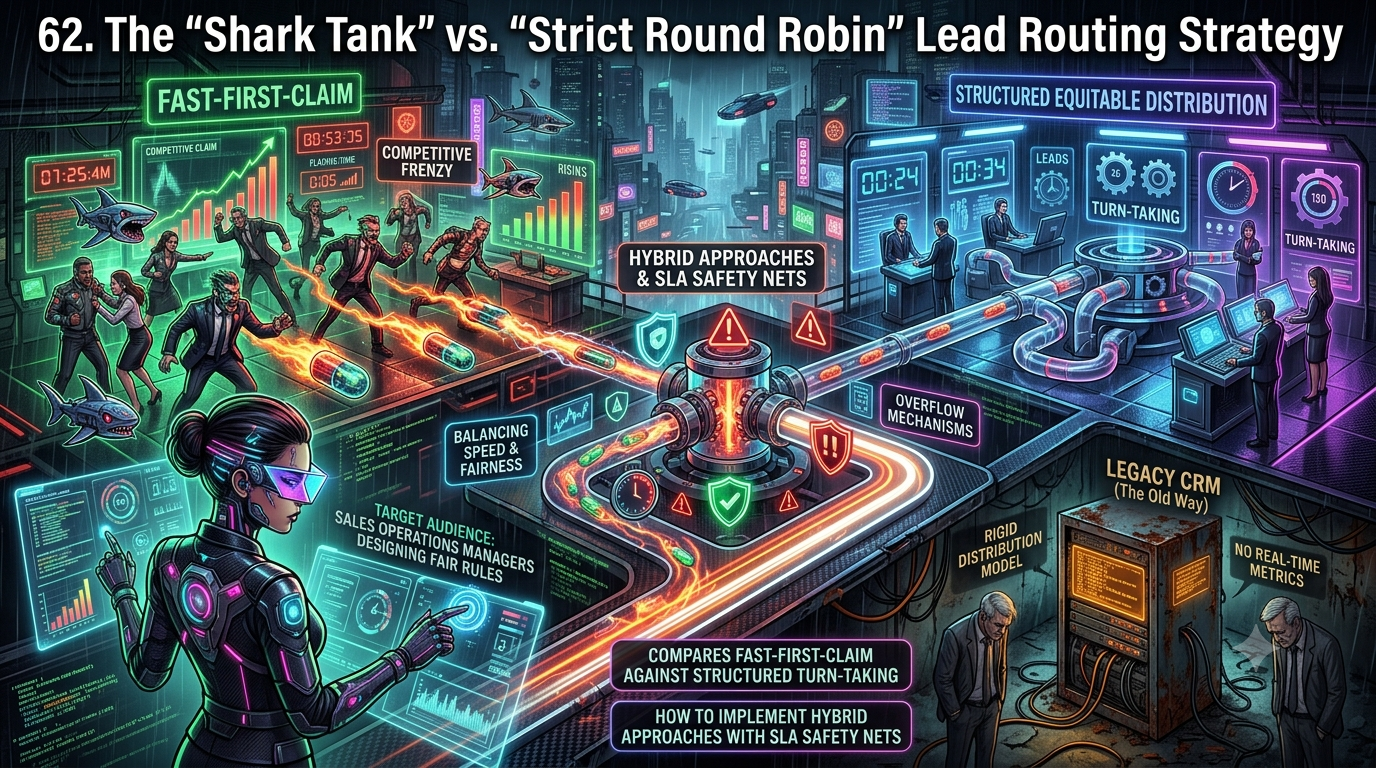
- A configurable SLA window (5 minutes, for example) starts the moment a lead is routed. If nobody claims it in time, InstaChime automatically escalates the lead to the next configured channel — the same operational pattern the lead-routing industry commonly calls a "Shark Tank" claim queue — instead of leaving it sitting untouched in one rep's queue.
Why Sales Teams Look for Zapier Alternatives for Lead Routing
Sales Ops teams don't usually leave Zapier because it's a bad product — they leave it because speed-to-lead workflows expose gaps that general automation tools weren't built to close.
- No native round-robin engine. Zapier has no built-in action for "assign to the next rep in rotation." Teams typically end up tracking the "last assigned rep" in an external spreadsheet or Zapier Storage, then reading and writing that value on every run — extra tasks, extra failure points.
- No SLA timers or automatic escalation. If a rep misses their turn, Zapier has no native concept of a missed claim. Nothing re-routes the lead; it simply sits assigned to someone who hasn't responded, and a human has to notice.
- Task-based pricing that scales with every step a lead touches, not with the number of leads. A workflow that creates a CRM contact, posts a chat alert, and logs a spreadsheet row is 3 tasks per lead — run that 500 times a month and you've used 1,500 tasks, several times over Zapier's 750-task Professional allotment. As of 2026, AI steps, code steps, and SDK calls draw from that same task pool, so adding any AI-assisted enrichment or scoring step to a lead Zap increases consumption further.
- No built-in claim-lock for first-to-claim models. Because Zapier is a sequential automation tool rather than a routing engine, preventing two reps from simultaneously claiming the same broadcast lead requires custom conditional logic rather than a native safeguard.
Feature Comparison: InstaChime vs. Zapier
| Workflow Capability | InstaChime | Zapier |
|---|---|---|
| Round-robin & weighted distribution | Native routing modes — round-robin and weighted routing are built into the platform's rule engine. | No native round-robin action; teams typically track "last assigned rep" in an external sheet or Zapier Storage. |
| SLA timing & escalation | Configurable claim window (e.g., 5 minutes) with automatic escalation to the next configured channel if a lead goes unclaimed. | No built-in SLA clock; timing has to be hand-built with Delay and Filter steps, and nothing auto-escalates a missed claim. |
| CRM handoff & webhook payloads | Sends a signed `lead.created` webhook payload with delivery history, manual retry controls, and dead-letter status for failed sends. | Webhooks by Zapier generates a "Catch Hook" URL for inbound triggers; Zapier's own docs warn to treat that URL like a password. |
| Pricing model | Flat plans by lead volume and seats — e.g., $79/month for 10,000 leads/month on the Growth plan. | Task-based billing — every action step (not the trigger) consumes one task, so a 4-step lead workflow burns 4 tasks per run. |
| Trigger speed | Leads land on a live claim dashboard as they're captured, with alerts pushed to chat, SMS, or browser push. | Polling-based triggers check roughly every 15 minutes on the Free plan and every 1–2 minutes on paid plans; only true webhook triggers are near-instant. |
*Published pricing and plan details as of August 2026 — confirm current rates on each vendor's pricing page before purchasing.*
How to Migrate from Zapier to InstaChime
1. Point your lead source at InstaChime first, and keep your existing Zaps running. Redirect your form, ad platform, or CRM webhook to InstaChime's capture endpoint instead of (or in addition to) Zapier's Catch Hook URL. You don't need to tear anything down — Zapier can stay connected as a downstream step.
2. Configure routing and SLA rules inside InstaChime. Choose round-robin, weighted, or rule-based routing for your team, set a claim window that matches your response-time target, and define what happens when that window expires — escalate to a manager, a broader pod, or a secondary channel.
3. Add InstaChime's outgoing webhook as a new Zap trigger for app fan-out. Once a lead is captured, routed, and claimed inside InstaChime, use its signed `lead.created` webhook to feed accepted leads into your remaining Zaps — Zapier becomes the connector for niche downstream apps, not the system tracking who owns the lead.
Frequently Asked Questions
Is InstaChime cheaper than Zapier for high-volume lead routing?
It depends on your step count and lead volume, so it's worth modeling both before switching. On Zapier, every action step in a lead workflow consumes a task and the trigger is free — a Zap that creates a CRM contact, sends a chat alert, and logs a spreadsheet row is 3 tasks per lead, so 500 leads a month can use 1,500+ tasks against a 750-task Professional allotment. InstaChime's Growth plan is a flat $79/month for 10,000 leads/month with routing, SLA tracking, and CRM handoff included, so the price doesn't move based on how many steps a lead touches.
Do I need a developer to set up round-robin or SLA escalation in InstaChime?
No. Round-robin, weighted, territory, skill-based, and rule-based routing are configured through InstaChime's dashboard, and SLA windows with automatic escalation are set the same way. Building equivalent race-condition-safe claim logic in Zapier — tracking last-assigned state, locking against double-claims, and timing out missed claims — typically requires custom webhook and Filter/Storage configuration closer to a developer or ops-technical task.
Can I use InstaChime and Zapier together instead of replacing Zapier entirely?
Yes, and it's the recommended migration path. Point your lead source at InstaChime for capture, routing, SLA tracking, and claiming, then use InstaChime's outgoing webhook to feed accepted leads into your existing Zaps for niche app fan-out. Most teams don't need to fully retire Zapier — they just stop using it as the system of record for lead ownership.