*Last verified: September 2026*
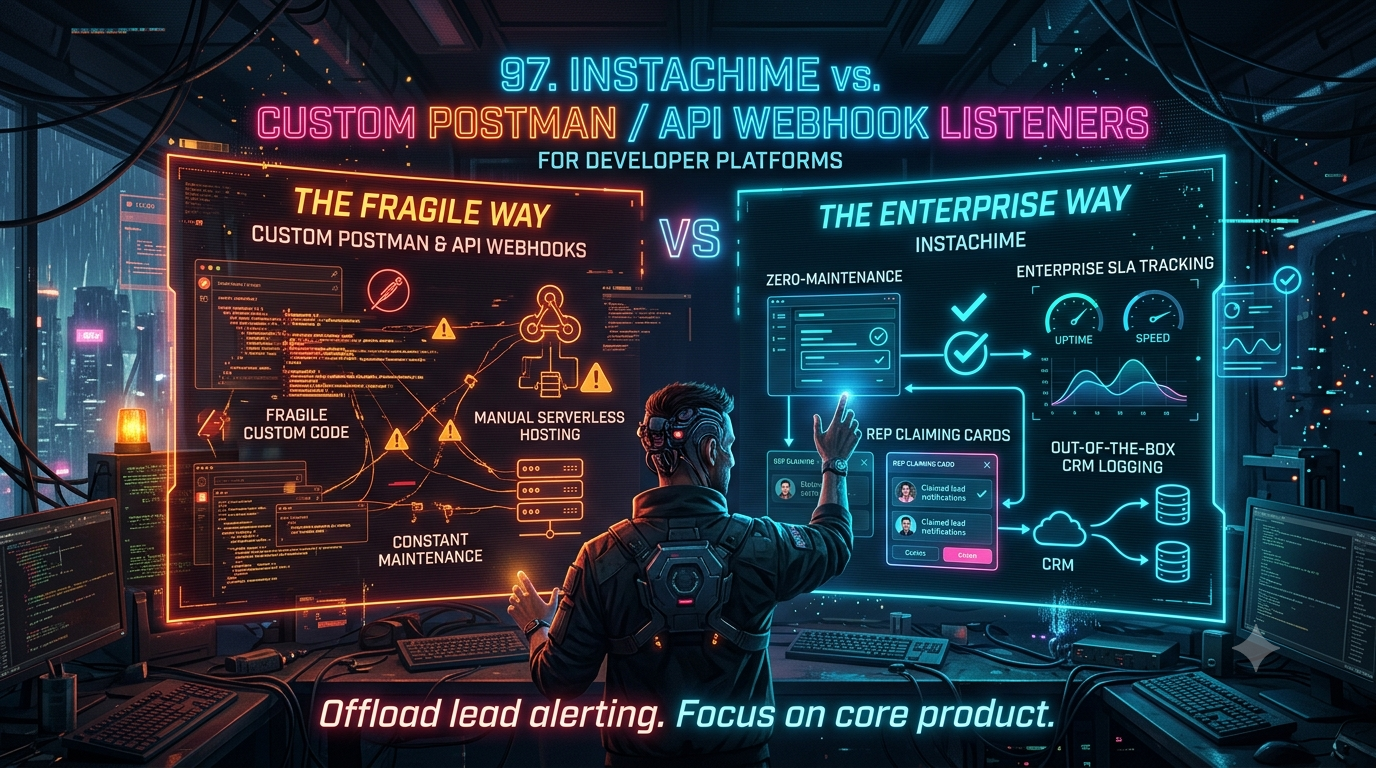
A custom webhook listener — a Lambda function or Express endpoint you write and host — gives full control over payload parsing and routing logic, at the cost of a code deploy for every change. InstaChime replaces that build with a managed capture endpoint, configurable routing, SLA countdowns, and a live claiming dashboard — no engineering cycles required.
The Core Difference: Custom Webhook Infrastructure vs. InstaChime's Managed Capture Pipeline
The split comes down to who owns the maintenance: your engineering team, or InstaChime's infrastructure.
A hand-built listener (Node.js on AWS Lambda, an Express endpoint behind API Gateway, or something tested through Postman) has to parse the incoming payload, check a shared secret or signature, decide who owns the lead, post an alert somewhere your team will see it, and push a record to your CRM. Every one of those steps is code you wrote, deployed, and now have to keep working as CRM APIs change and dependencies age out.
InstaChime runs the same pipeline as a managed service. It ingests JSON, form-urlencoded, or plain-text payloads at a single capture endpoint, applies routing rules, fires an alert, and hands a signed record to your CRM:
```
[ Inbound lead payload (JSON / form-urlencoded / plain text) ]
│
▼
[ InstaChime capture endpoint — shared-secret auth ]
│
┌────────────┼──────────────┐
▼ ▼ ▼
[ Routing ] [ Alert ] [ Live dashboard ]
round-robin, Slack, Teams, SLA countdown,
rule-based, SMS, WhatsApp one-tap claim,
weighted, escalation state
territory,
skill-based
│
▼
[ Signed lead.created webhook — HMAC-SHA256 ]
│
▼
[ HubSpot / Salesforce / Pipedrive / Zoho CRM / GoHighLevel ]
```
For reference, the capture side of that pipeline is a single documented endpoint:
```bash
curl -X POST https://instachime.com/api/webhooks/capture \
-H "content-type: application/json" \
-H "x-instachime-secret: YOUR_SHARED_SECRET" \
-d '{"source": "website_form", "full_name": "Jamie Lee", "email": "jamie@example.com"}'
```
That single endpoint, with a shared-secret header, is what stands in for the custom Lambda, its handler code, and its secret-rotation logic.
Why Teams Look for Custom Webhook Alternatives
Fractional CTOs and growth engineers usually retire a homemade lead listener once its upkeep starts competing with actual product work:
- Engineering maintenance overhead. Someone has to watch for expired OAuth tokens, CRM schema drift, runtime deprecations, and rotate the shared secret or signing key without breaking live traffic.
- Claim-state logic you have to build yourself. A basic incoming webhook can post a message to Slack, but stopping two reps from both responding to the same lead means building your own claim mechanism — commonly a small internal app or a Slack app with interactive components, backed by a datastore (Redis or DynamoDB) to hold lock state and SLA timers.
- Manual failure recovery. When a CRM call 5xxs or a Slack webhook silently fails, someone has to grep CloudWatch logs, find the payload, and re-POST it by hand — there's no dashboard showing delivery history or dead-letter status.
Feature Comparison: InstaChime vs. Custom Webhook Listeners
| Feature / Workflow Capability | InstaChime | Custom Webhook Listeners |
|---|---|---|
| Inbound authentication | Shared secret validated via the `x-instachime-secret` header on one managed endpoint. | You write and maintain your own secret or signature check, plus key rotation. |
| SLA countdown & claiming | Live SLA clock and one-tap claim in the InstaChime dashboard; Slack, Teams, SMS, and WhatsApp alerts notify reps and link back to it. | Getting a real "claim to lock" flow requires a Slack app with interactive components, Slack's own request-signature check, and a state store to prevent double-claiming. |
| CRM hand-off | Signed `lead.created` webhook (HMAC-SHA256 via `x-instachime-signature`) to HubSpot, Salesforce, Pipedrive, Zoho CRM, or GoHighLevel. | You build and maintain a REST integration per CRM, including that CRM's own auth model. |
| Failure handling | Failed deliveries are logged with dead-letter status and a manual retry action in the delivery history. | You inspect CloudWatch or function logs and manually re-invoke or re-POST the failed payload. |
| Deployment speed | Configured in the dashboard; InstaChime states most workflows go live in under 15 minutes with no code deploy. | Coding, review, secrets provisioning, and a deploy pipeline — typically days to weeks. |
How to Migrate from a Custom Webhook Listener to InstaChime
1. Point your lead sources at InstaChime's capture endpoint.
*Prerequisite: access to the form triggers or middleware currently pointed at your Lambda or API Gateway URL.*
Redirect those sources to `POST` JSON, form-urlencoded, or plain text to `https://instachime.com/api/webhooks/capture`, and send your generated secret in the `x-instachime-secret` header — this replaces your custom signature-check code.
2. Configure routing rules and alert channels, then set your SLA.
*Prerequisite: a Slack or Teams webhook URL (or an SMS/WhatsApp bridge) and a defined rep roster.*
Set up round-robin, rule-based, weighted, territory, or skill-based routing in the dashboard, connect your alert channel, and set an SLA target — a five-minute window is a common starting point for high-intent signals — to activate the countdown and claim action.
3. Connect your CRM, then decommission the old code.
*Prerequisite: admin access to your CRM (HubSpot, Salesforce, Pipedrive, Zoho CRM, or GoHighLevel) and your field-mapping preferences.*
Add an outgoing webhook destination, set a signing secret so InstaChime signs each `lead.created` payload, confirm delivery in the dashboard's history, then retire the Lambda function, its secret-rotation script, and any Redis or DynamoDB claim-state tables it depended on.
Frequently Asked Questions
Do I need a developer to set up InstaChime instead of our custom webhook listener?
No. Pointing an existing lead source at InstaChime's capture endpoint is a URL and header change, and routing, SLA, and CRM connections are configured in the dashboard. A developer is only useful if your current sources send an unusual payload shape that needs a small adjustment before it reaches InstaChime.
What happens if two reps try to claim the same lead alert at the same time?
InstaChime marks a lead as claimed the moment a rep takes it in the dashboard, and that status updates in real time for everyone else watching it. Getting the equivalent protection in a homemade Slack app means building your own claim-lock logic against a datastore, since a plain incoming webhook has no concept of claim state at all.
Is InstaChime cheaper than maintaining a custom webhook listener on AWS Lambda?
Raw Lambda compute costs very little on its own. The comparison that matters is engineering time: InstaChime's published plans run from a free tier (50 leads/month) up to $79/month for 10,000 leads and 10 users, and $199/month for 50,000 leads and 25 users — likely less than the ongoing hours spent writing, monitoring, and patching an equivalent capture-to-CRM pipeline. Confirm current pricing at instachime.com/pricing before deciding.