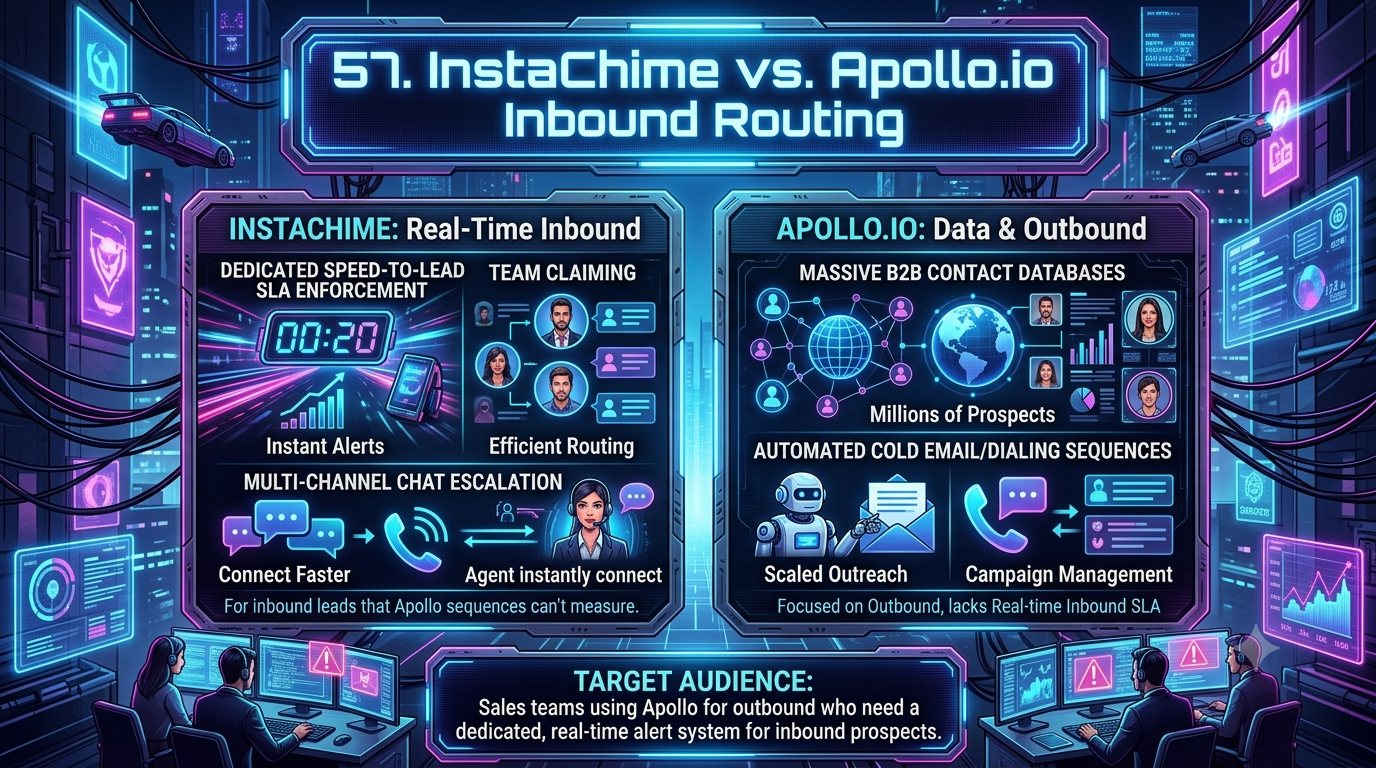
Apollo.io is built for outbound: a 275M+ contact database paired with cold email sequences and a dialer for high-volume prospecting. For inbound leads that need sub-30-second response times, InstaChime takes a different approach — live SLA countdown clocks, automatic escalation, and one-tap claiming built specifically for fast-moving sales teams that can't afford a missed webhook.
The Core Difference: Outbound Contact Database vs. Dedicated Speed-to-Lead SLA Enforcement
Apollo.io's architecture is database-first. Reps search a pool of 275M+ contacts and 73M+ companies, enrich records via waterfall data providers, and enroll prospects into email sequences or dialer queues. Apollo does offer an Inbound Router — it can assign leads by territory, expertise, or intent and trigger round-robin or if/else routing rules — but it's built as an extension of Apollo's scheduling and CRM sync layer, not as a standalone response-time system.
InstaChime is architected the opposite way: inbound-first. It captures a webhook payload the instant a form, ad platform (Google Ads, Meta Lead Ads, TikTok, LinkedIn), or Zapier event fires, starts a visible SLA clock against that specific lead, and pushes an alert to Slack, Microsoft Teams, SMS, WhatsApp, or browser push. If nobody claims the lead inside the configured window, it escalates automatically to a manager or a backup channel — no CRM refresh, no manual monitoring required.
In short: Apollo answers "who should own this lead eventually." InstaChime answers "who owns this lead right now, and what happens in the next five minutes if they don't respond."
Why Teams Look for Apollo.io Alternatives
Apollo's outbound engine is genuinely strong, which is exactly why it struggles as a dedicated inbound response tool. Sales and RevOps teams tend to hit the same three walls:
- Per-seat cost that scales against you. Apollo's Professional plan is $79 per user, per month (annual billing). A 10-rep team pays roughly $790/month just to keep everyone licensed — before credit overages. InstaChime's Growth plan is $79 per month flat, covering up to 10 users and 10,000 leads.
- Credit-metered access to core functionality. Apollo bundles verified emails, phone numbers, and enrichment into a shared, non-rollover credit pool — unused credits expire monthly, and phone lookups burn roughly 8x the credits of an email lookup. Teams that only want inbound alerting still inherit this credit math.
- SLA enforcement isn't a native, visible feature — it's something you build. Apollo's own guidance to RevOps teams describes SLA timers and escalation paths as logic you configure around the platform (often via workflows or a connected tool like Zapier), not a countdown clock reps see in their workflow by default.
- Workflow automation is tier-gated. Automated workflows and A/B routing logic show up starting at the Professional tier, so teams that only need lightweight inbound routing end up paying for outbound features (dialer, sequencing, intent data) they may never touch.
Feature Comparison: InstaChime vs. Apollo.io
| Feature | InstaChime | Apollo.io |
|---|---|---|
| Core architecture | Inbound-first: capture, route, alert, claim, and hand off live leads. | Outbound-first: query a 275M+ contact database and run email/dialer sequences, with inbound routing as an added module. |
| Lead alerting | Instant push to Slack, Teams, SMS, WhatsApp, and browser the moment a webhook fires. | Real-time notifications tied to the Inbound Router and CRM activity feed; no native SMS/WhatsApp bridge. |
| SLA enforcement | A live, visible countdown clock (e.g., a 5-minute target) attached to each individual lead. | SLA timers are a workflow you configure yourself; there's no native in-app countdown UI. |
| Missed-SLA escalation | Automatically reassigns the lead to a manager or backup channel per a configured priority path. | Requires manual workflow logic or a connected automation tool (e.g., Zapier) to reroute a missed lead. |
| Pricing model | Flat, workspace-level pricing — Growth is $79/month for up to 10 users. | Per-seat pricing plus a shared credit pool — Professional is $79/user/month, so costs multiply with headcount. |
How to Migrate from Apollo.io to InstaChime
1. Redirect your inbound sources. Point website forms, Google Ads, Meta Lead Ads, and any Zapier/webhook-based lead sources at InstaChime's capture endpoint instead of (or alongside) Apollo's Inbound Router. Keep Apollo connected if you still want it for outbound sequencing and database enrichment.
2. Configure routing and SLA rules. In InstaChime, set your priority paths — for example, a 5-minute SLA with top-rep routing for high-intent demo requests, and standard round-robin for lower-priority inbound. Define what happens on escalation (backup rep, manager, or a secondary channel) if the SLA window closes unclaimed.
3. Connect alerts and CRM handoff. Link Slack, Teams, or SMS/WhatsApp for rep-facing alerts, then set your CRM destination (Salesforce, HubSpot, Pipedrive, or GoHighLevel) so InstaChime pushes a clean, signed lead record — including claim timestamp and escalation history — the moment a rep takes ownership.
Frequently Asked Questions
Is InstaChime cheaper than Apollo.io for lead routing?
It depends on team size and what you're actually paying for. Apollo prices per seat ($49–$119/user/month depending on tier), so routing costs scale linearly with headcount and are bundled with outbound database credits. InstaChime prices per workspace — the Growth plan is $79/month flat for up to 10 users — so teams that only need inbound routing and alerting typically pay less as they add reps, without buying prospecting credits they won't use.
Do I need a developer to set up InstaChime?
No. InstaChime connects to common lead sources (Google Ads, Meta Lead Ads, TikTok, LinkedIn, Zapier, generic webhooks) and destinations (Salesforce, HubSpot, Pipedrive, GoHighLevel, Google Sheets) through a guided, no-code setup flow — pick your source, pick your alert channel, pick your CRM destination. No custom logic mapping or API code is required to launch a working routing rule.
Can I use InstaChime alongside Apollo.io?
Yes, and many teams do. Apollo.io remains a strong choice for building outbound pipeline — its 275M+ contact database, email sequencing, and dialer are built for prospecting at volume. InstaChime runs alongside it as the dedicated inbound response layer, capturing and routing the high-intent leads Apollo's outbound efforts generate (demo requests, pricing-page conversions) before they go cold.