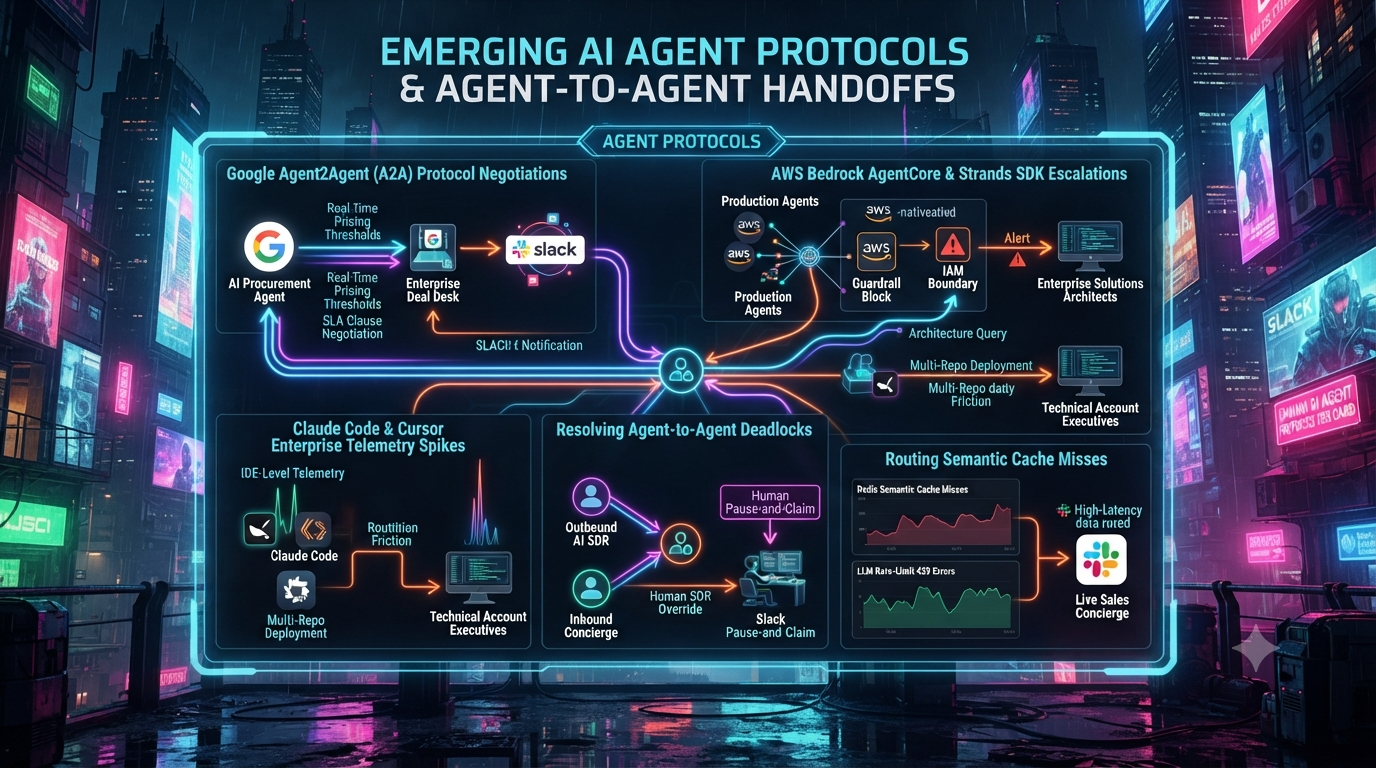
Enterprise AI architecture has moved beyond single-model chatbots and isolated RAG pipelines. Many teams now run networks of agents that query infrastructure, call tools, and execute multi-step workflows, sometimes across organizational boundaries. Early engineering adoption centered on the Model Context Protocol (MCP), originally from Anthropic, for tool access, and on orchestration frameworks such as LangGraph and CrewAI for internal state. The harder problem today is inter-agent communication, deterministic escalation, and human-in-the-loop (HITL) handoffs.
When autonomous agents interact across company borders, or collide inside your own sales and engineering workflows, unmonitored execution creates financial exposure, deadlocks, and a worse buyer experience. Revenue Operations (RevOps) and platform engineering teams can reduce that risk by pairing open interoperability standards with event-driven Slack routing, so that high-stakes edge cases move from autonomous execution to human ownership.
*Note: the numeric thresholds, timings, channel names, and payloads in this article are illustrative design examples, not industry benchmarks. Tune them against your own data.*
The State of the Protocol Landscape (November 2026)
Two open standards now sit under the same neutral governance:
- MCP: Anthropic donated MCP to the Linux Foundation’s new Agentic AI Foundation (AAIF) when it was formed on December 9, 2025, alongside Block’s goose and OpenAI’s AGENTS.md.
- A2A (Agent2Agent): Google launched A2A in April 2025 and donated it to the Linux Foundation on June 23, 2025. The project reached its first stable specification, v1.0, in March 2026. On August 17, 2026, A2A moved into the AAIF as a hosted project alongside MCP. The A2A project reports support from more than 150 organizations, including AWS, Cisco, Microsoft, Salesforce, SAP, and ServiceNow, and says the protocol runs in production in areas such as supply chains and financial services.
The Shift from Tool Calling to Inter-Agent Interoperability
The modern agentic stack has two distinct layers:
- Vertical context and tool access (MCP): MCP standardizes how a single agent connects to data sources, databases, and APIs. It answers: *How does an agent read a schema or execute a function?*
- Horizontal agent-to-agent communication (A2A): A2A standardizes how independent, opaque agents discover each other’s capabilities, delegate tasks, and track task state without exposing internal prompts, memory, or models. It answers: *How do agents built by different vendors collaborate?* AAIF describes the two as complementary: A2A sits at the collaborative edge and MCP at the tool-integration edge.
Runtime platforms such as Amazon Bedrock AgentCore can host agents that speak both protocols. AgentCore Runtime supports MCP and A2A, and works with frameworks including the open-source Strands Agents SDK, LangGraph, CrewAI, and others.
As horizontal communication scales, agents will hit boundaries they should not cross alone. Examples include discounting beyond approved margins, running into permission ceilings, and looping against another automated agent.
| Architecture Layer | Primary Standard / Framework | Core Responsibility | Example Human Escalation Trigger |
|---|---|---|---|
| External Negotiation | A2A (AAIF / Linux Foundation) | Cross-org task delegation, Agent Card discovery, task lifecycle | Custom SLA requests, non-standard payment terms, discounts below floor |
| Cloud Runtime & Governance | Amazon Bedrock AgentCore, Strands Agents SDK | Managed agent runtime, memory, identity, Cedar-based tool policy, observability | Guardrail blocks, permission denials, complex network-architecture queries |
| Developer Signals | Your docs MCP server, SDK and API telemetry (used by Claude Code, Cursor, and similar tools) | Showing which teams are integrating your product | Rate-limit friction, seat or quota exhaustion, multi-repo rollout patterns |
| Revenue Orchestration | AI SDR products (e.g., 11x, Artisan) plus inbound chat agents | Outbound prospecting and website qualification | Cross-agent messaging collisions, duplicate threads, VIP account detection |
| Inference & Caching Layer | Semantic cache (e.g., RedisVL, Redis LangCache) plus LLM gateways (e.g., LiteLLM, Portkey) | Fast cached answers and model routing | Cache misses on high-intent pages, upstream `429` rate limits |
1. Routing A2A Negotiations to Enterprise Deal Desks in Slack
How A2A Works
An A2A server publishes an Agent Card, a JSON document describing the agent’s identity, skills, capabilities, endpoints, and authentication requirements. Early versions of the spec placed it at `/.well-known/agent.json`. Since v0.3 (July 2025) the path has been `/.well-known/agent-card.json`, and v1.0 registered that suffix as a well-known URI. If you are working from a 2025 tutorial, expect field-level differences. For example, the v1.0 card lists supported interfaces instead of a single URL.
Clients send messages that create a Task. Messages carry typed parts (text, structured data, files), and agents return results as artifacts. A task moves through lifecycle states: `submitted`, `working`, `input-required`, `auth-required`, `completed`, `canceled`, `failed`, and `rejected`. The v1.0 wire format uses enum-style names such as `TASK_STATE_WORKING`. A2A v1.0 defines three transport bindings (JSON-RPC over HTTP, gRPC, and HTTP+JSON/REST), with streaming over Server-Sent Events. Security schemes on the card reuse the OpenAPI vocabulary, and v0.3 added signed Agent Cards.
The `input-required` state is what makes A2A useful for deal desks. A task can pause mid-flight, ask the caller for more, and resume.
The RevOps Risk: Autonomous Margin Erosion
Agent-mediated buying is an emerging pattern, not a universal one. Still, if a vendor’s A2A-enabled sales agent has broad authority to generate binding quotes, a buyer-side agent can probe systematically for discounts, extended payment terms, or bespoke SLAs. If the vendor agent instead rejects every non-standard request, high-value deals can stall in `failed` or `rejected` states with no human ever seeing them.
Implementing Deterministic Deal Desk Triggers
Don’t let the LLM decide whether to involve a human. Put a deterministic policy layer in front of the agent that evaluates each incoming message against business rules:
1. Pricing and discount thresholds: A requested discount above a defined limit (e.g., 15% off list) or a seat commitment above a defined size pauses autonomous completion.
2. Legal and SLA clauses: Classifiers flag indemnification changes, uptime guarantees above your standard, or data-residency requirements outside default regions. Treat classifier output as a trigger for human review, not a legal determination.
3. Interactive Slack deal desk card: When a rule fires, the middleware moves the A2A task to `input-required` and posts a Slack Block Kit message to a dedicated channel (e.g., `#deal-desk-a2a`).
Human approval can take minutes or hours, so design the exchange as asynchronous. Remote agents can poll the task, stream updates, or receive push notifications. Don’t rely on holding a connection open while a person decides.
An illustrative escalation payload:
```
{
"a2a_task_id": "task_98f3a1c0-4b2e-49d1",
"counterparty_agent": "procurement-agent.example.com",
"account_tier": "Enterprise",
"trigger_reason": "Custom SLA (99.99%) + 22% volume discount request",
"proposed_acv": "$240,000",
"slack_actions": ["Approve counter-offer", "Join live thread", "Escalate to Legal"]
}
```
When an Account Executive or deal desk analyst approves a counter-offer in Slack, the middleware returns it to the buyer agent as a new message or artifact on the same task, so negotiation resumes within human-authorized limits. If you need non-repudiation, sign the offer using your own mechanism. A2A’s Agent Card signing authenticates the agent’s identity, not each commercial offer.
Treat all content from external agents as untrusted input. A counterparty agent can embed instructions in a message just as a web page can, so keep pricing authority in code and policy rather than in the model’s prompt.
2. Routing AWS Bedrock AgentCore & Strands Escalations to Solutions Architects
Inside the AWS Agentic Production Stack
Amazon Bedrock AgentCore is AWS’s platform for building, deploying, and operating agents at scale. AWS describes nine services: Runtime, Memory, Gateway, Browser, Code Interpreter, Identity, Observability, Evaluations, and Policy. Several details matter for escalation design:
- Runtime: Each session runs in its own hardware-isolated Firecracker microVM, and the runtime works with open-source frameworks including the Strands Agents SDK.
- Memory: Episodic memory, added in December 2025, lets agents learn from past interactions.
- Policy: Introduced in preview in December 2025, Policy intercepts tool calls at the AgentCore Gateway and evaluates them against Cedar, AWS’s open-source policy language, outside the model. Check current availability before depending on it.
- A2A support: A2A agents on AgentCore Runtime must expose an Agent Card at `/.well-known/agent-card.json`.
Amazon Bedrock Guardrails and AWS IAM remain separate layers, covering content and contextual filtering and access control respectively.
Capturing High-Intent Technical Friction Signals
When prospects interact with your technical onboarding or pre-sales agent, certain runtime events are worth routing to a Solutions Architect (SA):
- Guardrail interventions: In the Bedrock Converse API, a blocked request or response returns `stopReason: "guardrail_intervened"`. If tracing is enabled, the response includes a guardrail trace with the assessment details. A cluster of interventions on topics like cross-account networking, key management, or regulated workloads can indicate a serious evaluation, or a guardrail that is too strict for your use case.
- Authorization failures: If your agent performs actions in a customer environment through delegated roles, `AccessDenied` errors tied to Service Control Policies or permission boundaries are a common proof-of-concept blocker. You will only see these if your agent runs the action and logs the result.
- Architecture-complexity signals: Questions about PrivateLink, cross-region failover, or Provisioned Throughput sizing often indicate production planning. Use semantic classification to detect them.
Routing Telemetry to Solutions Architects in Slack
Rather than letting an agent apologize repeatedly or improvise IAM policy JSON, add a small handler that converts these signals into routed events:
1. Detect and publish: Application code checks each response for guardrail interventions or tool-execution authorization errors and publishes a structured event to Amazon EventBridge. Your agent code emits the event, so define the schema yourself.
2. Enrich: A rule attaches CRM account context using your enrichment provider of choice.
3. Triage in Slack: An alert lands in a channel such as `#sa-escalations-aws` with the sanitized prompt, the relevant trace excerpt, the failing action, and a “Claim” button. Redact secrets and customer data before posting. Set an internal target for alert latency (a few seconds is a reasonable goal) and measure it.
4. Warm handoff: The SA joins with the exact error context, ideally through a Slack Connect channel or an existing support thread.
3. Routing Developer-Tool Adoption Signals to Technical Account Executives
Where the Signals Actually Come From
Developer-led companies have long used product-led growth signals such as workspace creation and API key generation. Agentic coding tools such as Claude Code and Cursor add new patterns. They can edit many files, run tests, and connect to MCP servers, including your product’s documentation server.
Be precise about visibility. Claude Code’s built-in OpenTelemetry metrics (for example `claude_code.token.usage`) are opt-in and flow to the customer’s own monitoring backend. As a vendor, you cannot see a customer’s internal Claude Code or Cursor usage. What you can legitimately observe is what touches your own systems: requests to your docs MCP server, SDK telemetry (where you disclose it and customers consent), API usage, and rate-limit responses. Follow your privacy policy and applicable data-protection law when you aggregate these signals by company.
High-Value Expansion Triggers
1. Docs MCP server adoption: Several users from one corporate domain querying your documentation MCP server, or unusually high automated query volume from one organization, suggests a team-level integration rather than individual experimentation.
2. Quota and rate-limit friction: A self-serve organization repeatedly hitting rate limits or seat caps, for example when parallel coding agents run integration tests against your API, is a natural moment for a conversation.
3. Multi-environment rollout patterns: One organization initializing credentials or configurations across many repositories or environments in a short window can precede a broader rollout.
Automated Routing to Technical Account Executives (TAEs)
Raw developer logs sent to non-technical SDRs tend to produce generic outreach that engineers ignore. Route aggregated signals to Technical Account Executives instead:
- Aggregation windowing: A stream processor or a Redis sliding-window counter groups events by corporate domain or organization ID over a rolling window (e.g., 6 hours) to limit alert fatigue.
- Composite thresholds: Alert only when several signals coincide, for example a minimum number of distinct users querying the docs server plus repeated rate-limit errors. Calibrate the numbers against accounts that later converted.
- Precision outreach: The Slack card shows which modules or endpoints the team is using, so the TAE can send a relevant, peer-level note, such as an offer of a temporary rate-limit increase and a shared Slack Connect channel.
4. Resolving Agent-to-Agent Deadlocks: Routing Conflicting AI SDR & Inbound Concierge Loops to Human SDRs
A Growing Failure Mode in Multi-Agent GTM Stacks
As revenue teams stack autonomous agents across the funnel, cross-agent state collisions become a practical risk. The AI SDR category is crowded. For example, 11x sells Alice, an outbound AI SDR, and Julian, an AI phone agent, and Artisan sells Ava as an end-to-end outbound agent. Many vendors also sell inbound chat or voice agents.
Consider a typical setup:
- An outbound AI SDR researches a VP of Engineering and runs an email and LinkedIn sequence.
- The same VP lands on your pricing page and starts a chat with your inbound website agent.
Without a shared real-time lock, the two agents can send conflicting messages, such as a self-serve link from one and an enterprise pilot pitch from the other. Worse, two automated systems can reply to each other’s scheduling emails in a loop.
Why Batch CRM Syncing Is Not Enough
CRM synchronization, whether scheduled or webhook-driven, can lag by minutes. In that window, both agents may already have contacted the same person. Coordination needs a lower-latency source of truth than the CRM.
Architecture of an Instant Pause-and-Claim Override
Use a fast shared state store, with Redis as a common choice, and a Slack override workflow:
1. Identity resolution and lock: Before any agent sends a message, it checks a centralized lock keyed by normalized email or domain (e.g., `prospect_lock:{normalized_email}`). In Redis, an atomic `SET` with `NX` and an expiry makes acquiring the lock safe under concurrency.
2. Collision detection and loop breaking:
- If an inbound session is active, the outbound agent receives a conflict response (for example HTTP `409`) and pauses.
- If an outbound sequence was sent recently and the prospect opens inbound chat, or message cadence suggests two automated systems replying to each other faster than a human could, a circuit breaker trips. Choose the time windows empirically.
3. Slack pause-and-claim card: Both agents are suspended for that prospect, and an alert goes to a channel such as `#sdr-live-overrides`. It includes the recent outbound messages and the inbound transcript. When the SDR clicks “Claim prospect and mute AI agents”, the lock is updated atomically with a longer expiry, the thread is assigned to that rep, and the rep replies with full context.
5. Routing Semantic Cache Misses & High-Latency Inference Fallbacks to Live Sales Concierges
The Hidden Conversion Risk in Agentic Web Experiences
Enterprise buyers expect fast answers. When a website agent depends on a frontier reasoning model plus multi-step retrieval, response latency can stretch to several seconds. During traffic spikes or provider rate limiting, visitors may see long spinners or generic error messages.
Semantic caching reduces both latency and cost. Instead of matching exact strings, it returns a stored response when a new query is semantically close to an earlier one. Redis offers this through the open-source RedisVL library (`SemanticCache`) and Redis LangCache, a managed semantic-caching service announced in 2025. LLM gateways such as LiteLLM and Portkey sit in front of model providers and handle routing and fallbacks. Note that RedisVL expresses its threshold as a *distance* (lower means stricter), so check which convention your library uses before tuning.
Two edge cases matter for pipeline:
1. High-intent cache misses: A visitor from a target account asks a novel, specific question that falls outside the similarity threshold, forcing the slow path.
2. Upstream limits and latency breaches: During a launch or campaign surge, token-per-minute quotas saturate and the provider returns HTTP `429`, or latency crosses your internal budget.
Semantic caches also carry a risk. If the threshold is too loose, a *similar* question can return a *wrong* answer, which is costly for pricing, security, or compliance topics. Exclude those categories from cache reuse, or require stricter matching.
Turning Infrastructure Signals into a Live Conversation
1. Gateway interceptors: The gateway tracks cache hit or miss, account enrichment (for example from reverse-IP lookup, subject to your privacy obligations), latency, and upstream status codes such as `429` or `503`.
2. Graceful bridge: If a miss or latency breach occurs on a high-intent page (such as pricing, enterprise, or security) for an ideal-customer-profile visitor, the widget shows a natural handoff message, such as offering to bring in a product specialist, and fires a webhook to Slack.
3. Slack claiming card: An alert posts to a channel such as `#live-sales-concierge` with the company, the question that missed the cache, and the page being viewed. When a rep clicks “Join live chat,” the Slack thread connects to the website widget, commonly over WebSockets.
Architectural Blueprint: Building a Unified Agent-to-Human Routing Layer
These five workflows don’t need five separate integrations. Mature teams unify them behind one HITL routing plane:
```
[A2A task events / webhooks] ─┐
[Cloud runtime events] ──────┼──► [Event Router & Identity Resolver] ──► [Redis State & Locks]
[Docs MCP / SDK telemetry] ───┤ │
[AI SDR / Inbound bots] ──────┤ ▼
[Semantic cache / LLM gateway]┘ [Policy & Threshold Engine]
│
┌────────────────┴────────────────┐
▼ ▼
[Autonomous Resume / Ack] [Slack Block Kit Escalation]
(Deal Desk / SA / TAE / SDR)
```
Core Engineering Best Practices
- Enforce idempotency on every escalation. Retries in distributed agent systems can flood channels with duplicates. Deduplicate with a deterministic key (for example `{protocol}:{session_id}:{trigger_rule}`) stored with a TTL before calling Slack’s `chat.postMessage`, and respect Slack’s API rate limits.
- Write state back after human resolution. When a person approves a discount, supplies an IAM fix, or claims a thread, store the outcome in the agent’s state so it doesn’t re-trigger the same rule immediately.
- Keep policy in code, not prompts. Thresholds, approval limits, and allowed tool calls should be enforced deterministically, for example with Cedar policies at the tool boundary on AgentCore. Prompt instructions alone are not a control.
- Log every handoff for audit. Record who approved what, when, and on which trace, especially for pricing and legal decisions.
- Measure escalation quality. Track the false-positive escalation rate (alerts humans dismiss as noise) and median time-to-claim, the time between card delivery and a human click. Set your own targets per channel. A live chat needs seconds, while a deal desk approval may reasonably take longer.
Frequently Asked Questions (FAQ)
How does the A2A protocol differ from the Model Context Protocol (MCP)?
MCP governs how a single agent connects to tools, APIs, and data sources. A2A governs how independent, opaque agents, often built by different organizations, discover each other through Agent Cards, delegate tasks, and exchange messages without sharing internal prompts, memory, or models. Both are now hosted by the Agentic AI Foundation under the Linux Foundation and are designed to be used together.
Why use Slack as the HITL control plane instead of a standalone dashboard?
Many revenue and solutions teams already work in Slack. Block Kit messages can carry pre-populated context and action buttons, so reviewers can act without switching tools. That can shorten response times, especially when a live visitor or a pending negotiation is waiting. Measure the effect in your own organization rather than assuming a fixed improvement. A dashboard still makes sense for audit and analytics.
How do you prevent infinite loops between autonomous AI SDRs and inbound chatbots?
Use a centralized, low-latency lock (typically in Redis) keyed by prospect email or domain. Each agent checks it before sending. A circuit breaker pauses both agents when a collision or unnaturally fast back-and-forth is detected, then routes the combined transcript to a human SDR in Slack.
What signals from developer tools indicate enterprise buying intent?
Vendors can’t see customers’ internal Claude Code or Cursor telemetry, but they can observe signals on their own systems. These include several users from one company domain querying your docs MCP server, repeated rate-limit or seat-limit friction, and multi-environment configuration activity in a short period. Aggregate these signals responsibly and in line with your privacy commitments.
Sources and Further Reading
- Linux Foundation, “Linux Foundation Announces the Formation of the Agentic AI Foundation” (December 9, 2025): <https://www.linuxfoundation.org/press/linux-foundation-announces-the-formation-of-the-agentic-ai-foundation>
- Linux Foundation, “Linux Foundation Launches the Agent2Agent Protocol Project” (June 23, 2025): <https://www.linuxfoundation.org/press/linux-foundation-launches-the-agent2agent-protocol-project-to-enable-secure-intelligent-communication-between-ai-agents>
- Linux Foundation, “A2A Protocol Surpasses 150 Organizations…” (April 9, 2026): <https://www.linuxfoundation.org/press/a2a-protocol-surpasses-150-organizations-lands-in-major-cloud-platforms-and-sees-enterprise-production-use-in-first-year>
- AAIF, “A2A joins AAIF’s open agentic stack” (August 17, 2026): <https://aaif.io/blog/a2a-joins-aaif>
- AAIF, “A2A v1.0: a builder’s guide” (Parts 1 and 2): <https://aaif.io/blog/a2a-v1-0-a-builder-s-guide-part-1-discovery-tasks-and-clients>
- AWS, Amazon Bedrock AgentCore FAQs: <https://aws.amazon.com/bedrock/agentcore/faqs/>
- AWS, “Amazon Bedrock AgentCore now includes Policy (preview), Evaluations (preview) and more” (December 2, 2025): <https://aws.amazon.com/about-aws/whats-new/2025/12/amazon-bedrock-agentcore-policy-evaluations-preview>
- AWS docs, AgentCore Runtime A2A protocol contract: <https://docs.aws.amazon.com/bedrock-agentcore/latest/devguide/runtime-a2a-protocol-contract.html>
- AWS docs, “Include a guardrail with the Converse API”: <https://docs.aws.amazon.com/bedrock/latest/userguide/guardrails-use-converse-api.html>
- AWS Cloud Operations Blog, “Analyzing Claude Code usage with CloudWatch and OpenTelemetry”: <https://aws.amazon.com/blogs/mt/analyzing-claude-code-usage-with-cloudwatch-and-opentelemetry/>
- Redis, “Introducing LangCache and vector sets”: <https://redis.io/blog/spring-release-2025/>