Introduction: Machine-to-Machine Buying Is Arriving Unevenly
The classic B2B funnel assumes a human reads a landing page, fills in a “Request a Demo” form, and waits for an SDR to reply. AI agents that research, compare and in some cases purchase on a buyer’s behalf are starting to bypass that funnel.
The data shows real growth but not yet mass adoption:
- Forecasts are aggressive. Gartner predicts that by 2028, 90% of B2B buying will be AI-agent intermediated, pushing more than $15 trillion of B2B spend through AI agent exchanges. That is a prediction, not a measurement.
- Agent traffic is growing quickly. HUMAN Security’s 2026 benchmark found that automated traffic grew about eight times faster than human traffic in 2025. Its report put growth in agentic AI traffic specifically at 7,851% year over year.
- Transactions lag behind browsing. In June 2026, e-commerce led agent traffic at 43.8%, followed by media and travel, while checkout and payment flows held steady at 2.34%. In May, financial services was only about 1% of agent traffic.
- Consumer checkout inside chatbots has stumbled. OpenAI ended Instant Checkout on March 24, 2026 in favor of discovery and merchant-run checkout. The underlying Agentic Commerce Protocol (ACP) lives on. Forrester reports that U.S. consumer adoption stayed low and stagnant until the product was discontinued.
- The tooling landscape has shifted. OpenAI’s standalone Operator was merged into ChatGPT agent. Google shut down Project Mariner on May 4, 2026 and folded its technology into Gemini Agent and other products.
On the buyer side, procurement platforms are adding agents. Pactum runs autonomous supplier negotiations and integrates with Coupa and SAP Ariba. Walmart is a well-known customer. Pactum’s CEO notes that most organizations start with low-risk transactions, typically under $50,000. Those tools mostly sit on the buyer’s side, negotiating with suppliers. Your sales stack is the counterparty.
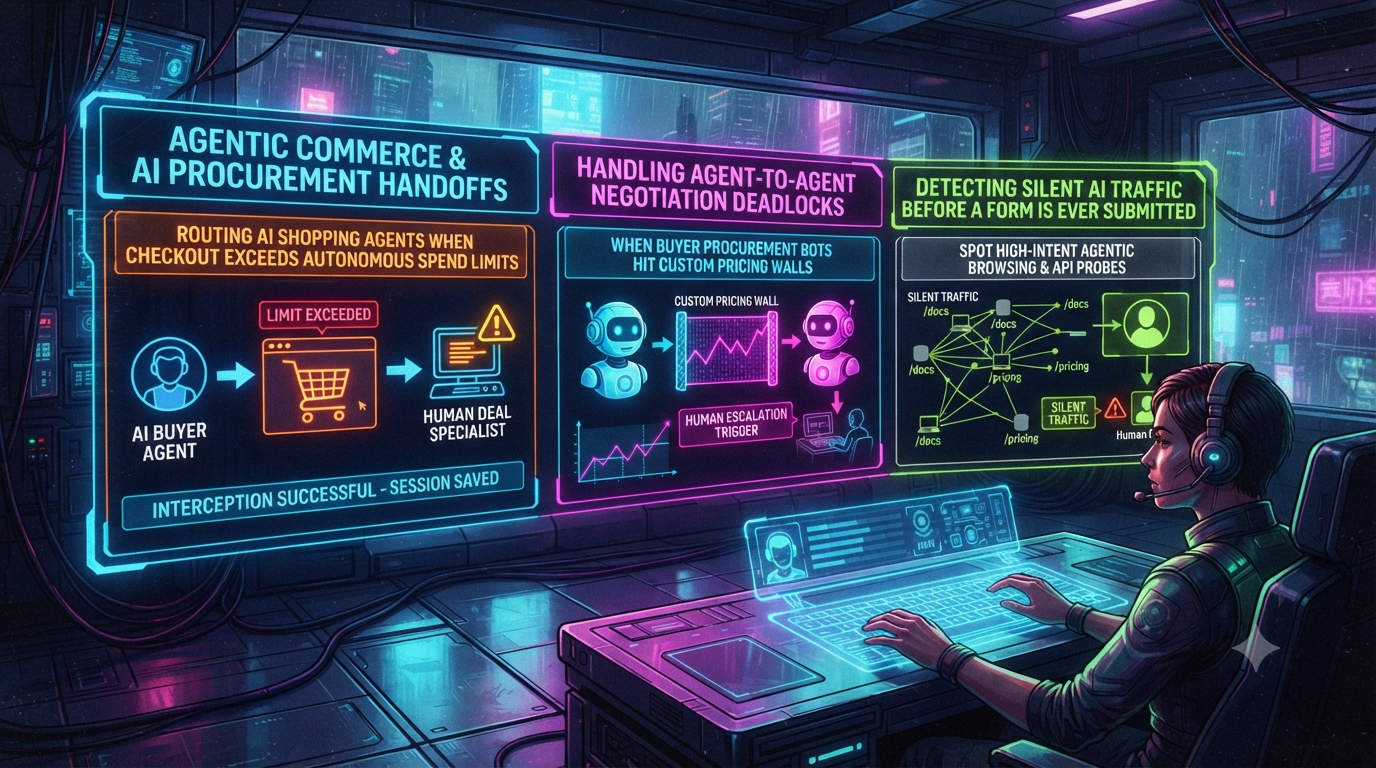
The practical conclusion for revenue teams is to prepare now, but to build for a mixed world of humans, browser agents and early autonomous buyers. Three capabilities matter:
1. Handing off to a human when a transaction exceeds an agent’s authorized spend.
2. Escalating agent-to-agent (A2A) negotiations that hit your policy limits.
3. Detecting agent traffic across docs and pricing pages before any form is submitted.
The architectures below are design patterns. Where an industry standard exists, it is named. Where something is an illustrative proposal, it is labeled as one.
1. Handling Checkout When a Purchase Exceeds an Agent’s Spend Authority
How agent spend limits actually work
Agents typically transact with delegated, scoped credentials rather than a human’s raw card:
- Stripe Shared Payment Tokens (SPTs) are restricted to a single merchant, carry usage limits and expiration, never contain raw card numbers, and can be revoked and monitored via webhooks. When the agent issues one, it sets currency, maximum amount and an expiration window.
- Visa Intelligent Commerce (launched April 2025) uses tokenized credentials and lets customers set spending limits and conditions. Visa’s Intelligent Commerce Connect is designed to accept payments initiated through Trusted Agent Protocol, Machine Payments Protocol, ACP and Universal Commerce Protocol.
- Mastercard Agent Pay uses Agentic Tokens built on its tokenization capabilities.
- Google’s Agent Payments Protocol (AP2), announced September 2025, uses signed “mandates.” In a human-present flow the user directly approves the closed Checkout and Payment Mandates. In a human-not-present flow the user pre-approves open mandates that constrain what the agent may do.
AP2 already defines a handoff primitive. Its specification says a human-not-present flow can be turned into a human-present one when the merchant or credential provider returns an `unresolved_constraint` error and brings the user back into the loop. If a cart breaks a mandate’s constraints, that is the standards-based moment to escalate to a human instead of failing.
What goes wrong at the boundary
Suppose a buyer’s agent assembles a software or supply order that exceeds its authorized single-transaction cap. Two things can happen:
- The agent’s policy blocks the purchase.
- Your self-serve checkout rejects the cart (too many seats or SKUs) and shows a static “Contact Sales” page.
In either case the agent has no good way to continue. A human-oriented sales process doesn’t speak its protocol, and a “we’ll be in touch” page gives it nothing to act on. Whether any given agent abandons or moves to a competitor is a design choice by its builder. It is a reasonable risk to plan for, not a measured rate.
A mid-cart interception pattern (illustrative design)
The table below is a recommended pattern, not an industry standard.
| Funnel stage | Legacy human-centric flow | Agent-aware design |
|---|---|---|
| Threshold trigger | Static error or “Contact Sales” link | Structured, machine-readable response stating why the cart was paused (for example, a `202 Accepted` with an escalation payload, or an AP2-style `unresolved_constraint`) |
| Session persistence | Cart lost on browser close | Signed cart/quote state token with an explicit expiry you choose |
| Rep notification | CRM round-robin email | Real-time alert with context pushed to Slack, Teams or your CRM |
| Buyer experience | Generic “we’ll be in touch” screen | Structured reply with a callback or polling endpoint and a stated response-time target |
Step 1: Return a machine-readable escalation. When your system recognizes an agent session, return structured data instead of a dead-end modal. Useful fields include:
- `escalation_id`, which references the exact cart configuration.
- `reason_code` (for example, `EXCEEDS_AUTONOMOUS_SPEND_LIMIT`).
- A callback or polling endpoint where the agent can retrieve the human’s response.
- An honest response-time estimate.
No standard schema for this exists yet. Use your own naming, document it, and map it onto A2A or AP2 constructs where you can.
Step 2: Push a live claiming card to the right account executive. The card should show:
- Who the buyer is (from OAuth identity or billing metadata).
- The exact cart.
- Why the agent paused.
- One-click actions: claim the session, generate a revised quote, or open a shared thread with the human approver.
Whether speed wins deals is an empirical question for your market. Track time-to-first-response and win rates on escalated agent sessions so you can find out.
Step 3: Offer a compliant split-authorization path. Often the buyer’s agent needs the transaction restructured to fit its authority. Options include:
- A payment link that routes approval to the buyer’s human manager.
- A quote the agent can hold while approval is pending.
- A partial charge up to its limit, with the remainder invoiced.
Do the last one only if the buyer’s own policy allows it. Splitting a purchase specifically to slip under an approval threshold can violate the buyer’s controls and your own compliance rules.
2. Handling Agent-to-Agent Negotiation Deadlocks
Buyer-side negotiation agents already exist at scale for supplier negotiations, and sellers are beginning to deploy quoting agents of their own. The protocol layer is maturing. The A2A protocol passed 150 supporting organizations in April 2026. In August 2026 it was moving to the Agentic AI Foundation, alongside the Model Context Protocol (MCP). MCP connects agents to tools and data, while A2A handles communication between independent agents.
A2A already includes the primitives for a human handoff. A task moves through submitted, working, completed and other states, including `input-required` and `auth-required`. Interactive states resume to working once the client responds. A seller agent that needs human sign-off can pause a task instead of rejecting it.
Common causes of deadlock
1. Policy mismatch. The buyer’s agent requires Net-90 terms and a 99.99% uptime SLA, while your agent is authorized only for Net-30 and 99.9%.
2. Concession loops. Two LLM-driven agents can trade tiny concessions without converging unless you cap the turns.
3. Levers outside the catalog. The buyer demands a price cut below your floor. A human deal desk could instead offer free onboarding or a billing deferral, but those levers aren’t in your agent’s schema.
4. Legal and compliance triggers. Data-residency, liability, indemnification or escrow demands need legal review. If the buyer cites India’s DPDP Act, be accurate about what it requires. The DPDP Rules, notified in November 2025, permit transfers of personal data outside India, subject to restrictions the Central Government may notify, and the Act does not impose a universal requirement to store all personal data in India. Sector rules and contractual demands can still require local storage, so route these to counsel.
Deterministic circuit breakers
Don’t let an LLM invent margins or contract terms. Put it behind a deterministic policy layer, such as a rules engine or Open Policy Agent, that enforces limits and pauses automatically. Illustrative triggers, with thresholds you should set from your own deal data:
- Margin floor. If a counter-offer would breach your minimum margin, pause for review instead of flatly rejecting.
- Turn limit. If the price and term gap hasn’t narrowed meaningfully after a set number of turns, stop automated concessions.
- Non-standard clause detection. Flag mentions of custom indemnification, liability caps, source-code escrow or bespoke payment schedules.
A warm-handoff payload (illustrative)
The payload below is a design example, not a standard. The numbers are hypothetical.
```
{
"session_state": "ESCALATED_TO_DEAL_DESK",
"negotiation_summary": {
"buyer_org": "Global Logistics Corp",
"requested_skus": ["ENT-CORE-500", "API-ADDON-PRO"],
"buyer_target_arr": 145000,
"seller_floor_arr": 162000,
"deadlock_variables": [
"payment_terms: requested Net-60 vs policy Net-30",
"unit_discount: requested 22% vs max_autonomous 15%"
]
},
"human_specialist_eta_seconds": 240,
"hold_quote_validity_minutes": 60
}
```
The deal desk should receive a short brief of trade-off levers. For example: “The buyer agent is stuck on a $17,000 gap. Approve Net-60 terms plus three months of free onboarding to close at the $162,000 floor without cutting unit price.” After the human approves, the seller agent resumes the session and sends the structured counter-offer back to the buyer’s agent.
3. Detecting Agent Traffic Before a Form Is Submitted
Some agent visits never produce a form fill. A buyer might ask an assistant to compare vendors that meet specific security, deployment and price criteria, and your site is evaluated and dropped from the shortlist without a trace in your CRM. Call this “silent AI traffic.”
Not all agents look alike in analytics
- Headless fetchers retrieve pages or APIs without running JavaScript. Traditional pixel-based analytics miss them.
- Agentic browsers run a real browser. HUMAN reported in April 2026 that agentic browsers generated nearly three-quarters of agentic traffic, and its benchmark notes that agentic browsers complete account logins and checkout flows. These sessions can look like ordinary human visits in browser-based analytics.
Don’t assume agents skip JavaScript or cookies. Instrument both the edge and the page.
Verify identity where you can
Agent identity is the weakest link. HUMAN’s report acknowledges that operator identification relies on user-agent strings and infrastructure signals, and that self-declared identity is unreliable. A stronger option is emerging.
- HTTP Message Signatures (RFC 9421) have been a Proposed Standard since February 2024.
- Web Bot Auth is an IETF draft that builds on them. A client signs requests and points to a public key directory via a `Signature-Agent` header, so a site can verify which operator sent a request.
- Cloudflare’s signed agents are generally directed by an end user and sign with Web Bot Auth. The first cohort was ChatGPT agent, Goose, Browserbase and Anchor Browser. AWS WAF also exposes labels for verified Web Bot Auth traffic.
- The limits are stated in the draft itself. A valid signature says nothing about who operates the agent, whether it is benign, or whether the request is authorized. Those remain your policy decisions. The draft also warns that signed messages can be replayed.
Behavioral signals to test (hypotheses, not benchmarks)
No public benchmark defines what a procurement agent’s traffic looks like. Treat the following as hypotheses to validate against your own logs:
| Signal | Likely generic crawler | Possible buying or evaluation agent |
|---|---|---|
| Path | Broad crawl of blogs and sitemaps | Focused visits to pricing, security, SLA and API docs |
| Content touched | Page text | Pricing calculators, rate-limit tables, compliance pages, changelogs, OpenAPI specs |
| Timing | Steady background crawling | Short burst of related requests, possibly repeated later |
| Parameters | Static URLs | Specific filters such as `?seats=250®ion=ap-south-1&sso=saml` |
A note on `llms.txt`
Many guides tell you to publish an `llms.txt` file for agents. The evidence is mixed. Ahrefs found that 97% of `llms.txt` files received zero requests in May 2026. Fewer than a fifth of the requests that did arrive came from named AI tools, led by GPTBot and Claude Code. Google’s AI guidance says AI Overviews and AI Mode don’t use it. It still has a niche value for developer-facing documentation, where coding agents read it. Don’t count on it to reach buying agents.
Put your effort into well-structured HTML, published OpenAPI specifications, and pricing and security pages that load without brittle client-side rendering.
Turning agent signals into sales action
1. Log and classify agent traffic at your CDN or edge, separating verified (signed), declared and unverified agents.
2. Correlate with account intent where lawful. Combine the signals with your existing intent data (6sense, Demandbase and similar tools) and recent outreach. Treat network-level matches as probabilistic, since agents often run from shared cloud infrastructure.
3. Alert the account owner with the specific pages and questions the agent probed, then send a relevant human message. Respect privacy law and your consent policies when linking anonymous sessions to named people. For example:
> *“Hi Priya, teams evaluating our enterprise API tier for multi-region deployments usually ask about custom rate limits and data-protection documentation. Here’s our architecture brief, and I can set up a sandbox if your team is benchmarking this week.”*
4. Offer a clean machine path. If you publish an agent-facing quote or RFQ endpoint, authenticate it, rate-limit it, and treat anything submitted to it as untrusted input.
Implementation Roadmap
You don’t need to replace your CRM or e-commerce platform. The timeline below is a suggestion; adjust it to your team.
Phase 1: Machine-readable foundation (weeks 1–2)
- Make pricing, SLAs, security certifications and API documentation available as clean, crawlable pages without JavaScript walls.
- Publish current OpenAPI specifications.
- Optionally add `llms.txt` if you have developer documentation, and keep it in sync with your real pages.
Phase 2: Edge telemetry (weeks 3–4)
- Log requests to pricing, docs and security paths at the CDN or edge, and verify Web Bot Auth signatures where supported.
- Use `robots.txt` and bot-management rules to separate training crawlers from user-directed agents.
- Feed high-intent agent bursts into a dedicated Slack channel or CRM view.
Phase 3: Checkout and quote escalation (weeks 5–8)
- Audit every point where volume caps or approval limits produce a dead-end error.
- Return structured escalation responses, and consider supporting AP2-style human-in-the-loop handoffs if your payment stack uses it.
- Build the live claiming card and a documented split-approval path.
Phase 4: Guardrailed negotiation (weeks 9–12)
- Deploy a seller-side quoting agent that can answer structured RFQs over API, MCP or A2A.
- Wrap it in deterministic policy checks and deal-desk circuit breakers, and log every concession for audit.
Key Takeaways
- Plan for a mixed audience. Forecasts are bold, but measured agent activity is concentrated in e-commerce, media and travel, and checkout is a small share of it so far. Build handoffs that work for humans, browser agents and fully autonomous buyers.
- Use the standards that exist. AP2’s `unresolved_constraint` flow and A2A’s `input-required` state are real handoff mechanisms. Custom escalation schemas should map onto them.
- Keep humans in charge of exceptions. Let agents handle standard configurations, and route custom pricing, legal terms and spend-limit exceptions to account executives and deal desks.
- Verify, don’t assume. Cryptographic signatures prove which operator sent a request, not whether it is trustworthy or authorized. Combine them with behavioral signals and your own policy.
- Measure your own funnel. Track agent sessions, escalations, response times and win rates. These are the numbers that will tell you how much of this shift is reaching your business.